
About the Journal
WELCOME TO WEBSITE OF
BULLETIN OF THE CHEMISTS AND TECHNOLOGISTS OF BOSNIA AND HERZEGOVINA
(GLASNIK HEMIČARA I TEHNOLOGA BOSNE I HERCEGOVINE)
Bulletin of the Chemists and Technologists of Bosnia and Herzegovina (Glasnik hemičara i tehnologa Bosne i Hercegovina) publish original and significant work in the chemical, technological, pharmaceutical, and closely related areas of research. Reviews, scientific articles, and short communications are welcome. The journal is published semiannual, and full text version of the papers published are available free of cost in Acrobat Portable Format (PDF).
Website Migration Notice
We would like to inform our authors, reviewers, and readers that the Bulletin of the Chemists and Technologists of Bosnia and Herzegovina is currently transitioning to a new journal website as part of the implementation of the Open Journal Systems (OJS) platform.
During the transition period, old website will remain available to ensure uninterrupted access to the journal and its content.
- Old website: https://hemija.pmf.unsa.ba/glasnik/
The migration to the new OJS platform is expected to be completed by the end of this year, after which the new website will become the journal's official online platform.
We appreciate your patience and understanding during this transition and look forward to providing an improved publishing and manuscript management experience through the OJS system.
Bulletin of the Chemists and Technologists has been licensed for indexing in:
Emerging Sources Citation Index (Web of Science, Clarivate Analytics): See the listing
Academic Search Complete (EBSCO): See the listing
CAPlus (Chemical Abstracts Plus): See the listing
Google Scholar: Browse the articles
Current Issue
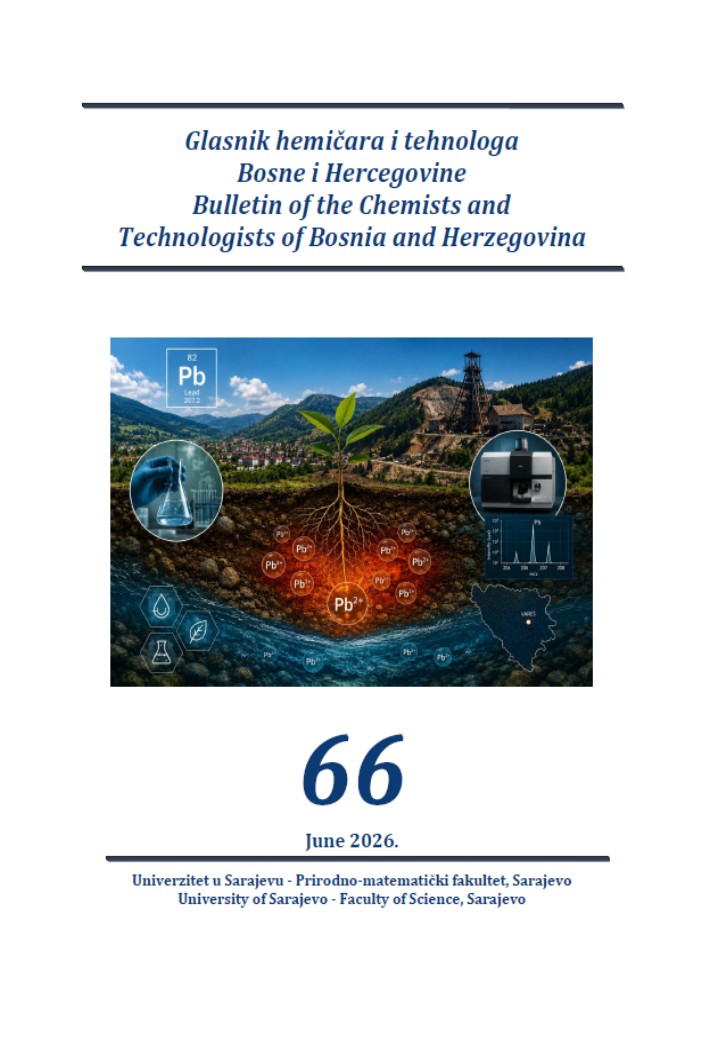
Lead poisoning, also known as plumbism and saturnism. Exposure to lead can occur through contaminated air, water, dust, food or consumer products. Children are at greater risk because they are more likely to put objects in their mouths, such as those containing lead paint, and absorb a large amount of the lead they swallow. Occupational exposure is a common cause of lead poisoning in adults with certain occupations at particular risk. The diagnosis is usually made by measuring lead levels in the blood. The Centers for Disease Control and Prevention (CDC US) have set the reference level for blood lead for adults at 10 µg/dL (10 µg/100g) and for children at 3.5 µg/dL.
Classically, "acute lead poisoning" or "chronic lead poisoning" is defined as exposure to high levels of lead that are usually associated with severe health effects.
Diagnosis and treatment of lead exposure are based on the blood lead level (the amount of lead in the blood), measured in micrograms of lead per deciliter of blood (μg/dL). Urine lead levels may also be used, although less frequently. In cases of chronic exposure, lead is often sequestered in the highest concentrations first in the bones, then in the kidneys. If the provider performs a provocative excretion test, or "chelation challenge," a measurement obtained from urine rather than blood is likely to provide the healthcare provider with a more accurate representation of total lead burden.
Lead forms a wide range of compounds and exists in the environment in various forms. Organic lead poisoning is now very rare, as countries around the world have phased out the use of organic lead compounds as gasoline additives. However, such compounds are still used in industrial settings. Organic lead compounds, which readily pass through the skin and respiratory tract, primarily affect the central nervous system.
Lead poisoning is preventable. This involves individual measures such as removing lead-containing items from the home, and workplace interventions such as improved ventilation and supervision.
Lead poisoning can be acute (from intense short-term exposure) or chronic (due to repeated low-level exposure over a long period), but the latter is much more common.
Poisoning by organic lead compounds predominantly manifests with symptoms in the central nervous system, such as insomnia, delirium, cognitive deficits, tremors, hallucinations, and convulsions. In acute poisoning, typical neurological signs are pain, muscle weakness, numbness, and tingling, and rarely symptoms related to inflammation of the brain. Other acute symptoms include abdominal pain, nausea, vomiting, diarrhea, and constipation. Effects of lead on the mouth include astringency and a metallic taste. Gastrointestinal problems, such as constipation, diarrhea, poor appetite, and weight loss are common in acute poisoning.
Lead poisoning can cause a wide range of symptoms and signs that vary depending on the person affected and the duration of lead exposure. Symptoms are nonspecific and can be subtle, and someone with elevated lead levels may not have any symptoms. Symptoms usually develop over weeks to months as lead accumulates in the body during chronic exposures, but acute symptoms also occur with short, intense exposures.
Original Scientific Article
<h1>Glasnik hemije i tehnologije Bosne i Hercegovine</h1> <p>International peer-reviewed open access journal</p> <a href="/index.php/bctbh/about/