Aqueous Solvation of Charges and Hydrophobic Groups
Abstract
Much of biology depends on proteins interacting with each other – pairwise or in aggregates – all mediated by water and ions. Understanding the aqueous solvation of electrolytes, simple and complex, is therefore important for biology, as also for industry. Today's solvation models mostly apply to dilute solutions and, despite being supported by all-atom simulations, do not yield good results for thermodynamic properties. In recent years statistical-mechanics was applied to such systems using Wertheim's integral equation theory, which is well suited for systems of molecules with directional forces. Such an approach is able to treat mixtures of water molecules, ions and proteins, with all species treated on equal footing. The presentation begins with aqueous solutions of alkali halides to show the effects of ionic sizes of salt-forming ions on osmotic properties of the solution, followed by discussion of how the presence of hydrophobic groups affects the solution energetics, and concludes with discussion of protein self-association, showing that the free energy of hydration of interacting ions and charged groups is a crucial parameter.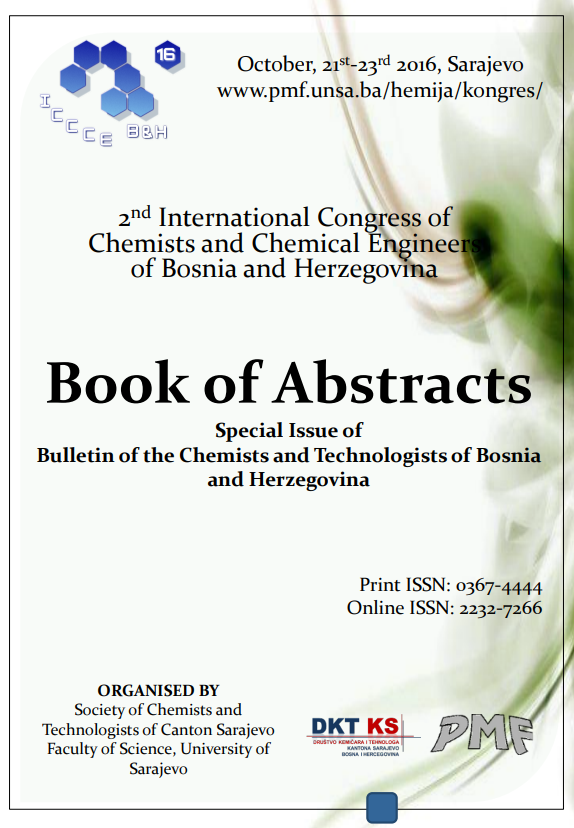
Downloads
Published
2016-10-21
Issue
Section
Plenary Lectures
How to Cite
Vlachy, V. (2016) “Aqueous Solvation of Charges and Hydrophobic Groups”, Bulletin of Chemists and Technologists of Bosnia and Herzegovina, (2 Special Issue), p. 11. Available at: https://glashem.pmf.unsa.ba/index.php/bctbh/article/view/371 (Accessed: 29 July 2026).