
Vol. 56 (2021): Bulletin of the Chemists and Technologists of Bosnia and Herzegovina
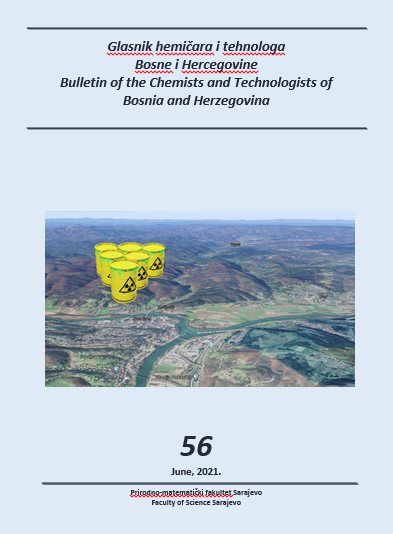
The disposal of radioactive waste is the last stage in radioactive waste management and it is oftentimes considered as a permanent waste category. The main goals of the construction of radioactive waste repositories are the protection of people and environment from harmful radiological and non-radiological impact, as well as storing the waste in a way that leaves minimal responsibility for radioactive waste management to future generations. In accordance with the recommendations of regulatory authorities in this field (IAEA, EU directives, Euratom directives,…), as a prerequisite for the construction of this type of repositories is the choice of location, or its characteristics (geological and geochemical structure, soil porosity, presence of surface water and groundwater – their flow and chemical composition, seismic characteristics of the location and environment, relevant climatic conditions, presence of populated areas, risk of fires,…). Also, in order for a repository to function properly, the radioactive waste classification is crucial, on the basis of which the criteria for the design and type of repository can be further defined.
Trgovska gora, ie. the Čerkezovac site, has been selected by the Republic of Croatia as a site for radioactive waste disposal (including the treatment, conditioning, manipulation, long-term storage and disposal of radioactive waste, in particular used radioactive sources and spent nuclear fuel). The site is located on the border with Bosnia and Herzegovina (Čerkezovac is located only 850 meters away from the Una National Park), which obliges the Republic of Croatia to adhere to the ESPOO Convention and the Aarhus Convention. According to the available data, the location of Trgovska gora is a terrain naturally unfavorable for radioactive waste disposal. The soil consists mainly of sedimentary rocks and a smaller share of metamorphic rocks, whose vertical development is insufficiently explored. There are surface water and groundwater, which in synergy with other factors (terrain slope, infiltration, vegetation, climatic conditions, floods, etc.) implies the direction of distribution and fast migration of contaminants to the protected area within the “Natura 2000” network, river Una, and the present settlements within the territory of Bosnia and Herzegovina. In addition, the seismic conditions of this location are unfavorable, and since the area is fich in forests, there is a possibility of fires of natural and anthropogenic origin. Also, the construction of radioactive waste landfills in the area of Trgovska gora will inevitably lead to an adverse impact on further prospects for the survival of the local population and development of the area, even in the best case scenario which assumes the impossibility of radionuclide leakage into the environment.