Vol. 52 (2019): Bulletin of the Chemists and Technologists of Bosnia and Herzegovina
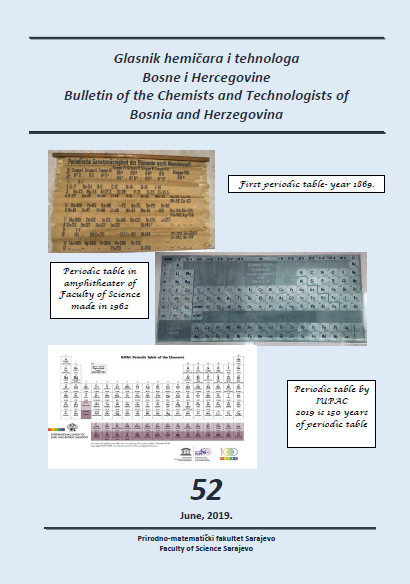
THE INTERNATIONAL YEAR OF THE PERIODIC TABLE
Advances of modern chemistry have in numerous ways transformed the lives of humans in ways once thought unimaginable. These developments once applied to the multitude of disciplines including industry, medicine, food production have led to a dramatic increase in population and in general quality of life and health of humanity as a whole. In an age of ever-increasing specialization and complexity, one can easily overlook that all of that advancement and experimentation boils down essential building blocks of matter, the atoms, and their classification as elements.
The general characterization of matter has existed from the ancient times in both philosophical and scientific manner, however, for centuries it was quite arbitrary and differed widely between different civilizations. In the European middle ages existed a fixation of many with the mostly mystical transmutation of matter, including the notable search for so-called “Philosopher's stone”. While these early experimentations where barely scientific in nature they did show that characteristics of materials can be manipulated and these have led to the discovery and classification of the first elements, even if though their properties where barely understood. As science progressed it became clear that all matter is made up from particles that were named atoms, with their first classification made by Antoine-Laurent de Lavoisierwhich and which were thought for a long time to be fundamental particles. With the accumulated knowledge of known elements relative atomic masses, in 1869 Dmitri Ivanovich Mendeleev published a table which is considered a first modern periodic table of elements in which known elements were arranged according to their properties with blank spaces being filled with further discoveries of new elements. This trend continues to this day with synthesis and characterization of short-lived highly unstable elements as well as different isotopes of known ones.
In the recognition of huge impact the creation and subsequent expansion of periodic table has had for the entire human civilization the year 2019, which is 150 years since the publication of Mendeleev’s periodic table, has been declared by the United Nations General Assembly and UNESCO as “The International Year of the Periodic Table” with the aim of further promoting and supporting development of science and technology through the humanity.