
Vol. 54 (2020): Bulletin of the Chemists and Technologists of Bosnia and Herzegovina
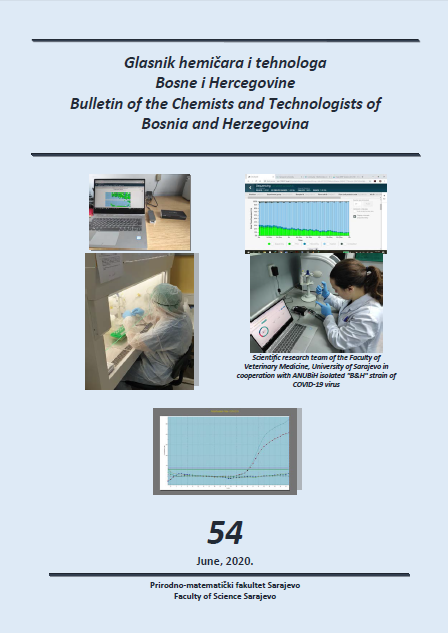
At the end of 2019, a new SARS-like virus was detected in China, which was later named SARSCoV-2. This virus has since then caused hundreds of thousands of deaths linked with to the respiratory disease COVID-19. A cure or a vaccine has not yet been discovered, but in the meantime, all we can do is protect ourselves and/or others surronding us. In order to do that, testing and effective contact tracing are essential.
The most common tests used to detect the presence of COVID-19 are PCR and serologic tests. PCR tests detect the presence of an antigen, rather than the presence of the body's immune response, or antibodies. Unlike PCR tests, serologic tests detect the presence of antibodies. Different samples are needed in order to perform these tests: PCR tests usually require a nasopharyngeal swab, and serologic tests require a blood sample.
The polymerase chain reaction (PCR) is an in vitro method used for amplifying specific sequences of nucleic acids. This method was discovered by Kary Mullis in 1983. Using this technique, it is possible to analyse minimal traces of nucleic acids (NA).
The basic ingredients for a PCR are Taq polymerase, primers, template NA and nucleotides. These substances are combined in a tube along with cofactors needed by the enzyme, and are put through several cycles of heating and cooling that allow NA to be synthetized. The DNA which needs to be detected is the DNA of the virus-infected host cells.
The essential steps are:
1. Denaturation of the DNA strands (at 96°C),
2. Annealing of primers to their complementary sequences on the single-stranded template DNA (at 55-65°C),
3. Extension of the primers, thus synthesizing new strands of DNA (at 72°C).
A fluorescent signal is created when amplification occurs, and once the signal reaches a threshold, the test is considered positive. The technique is generally very sensitive and specific. If a PCR test is positive, the result is most likely correct (false positive results can only happen if the samples are contaminated during test processing). False negative results do not guarantee that the patient is not infected by the virus and they are most frequently the result of a wrong patient sampling (swabs not pushed far enough in the patients' nasopharynx, i.e.).